
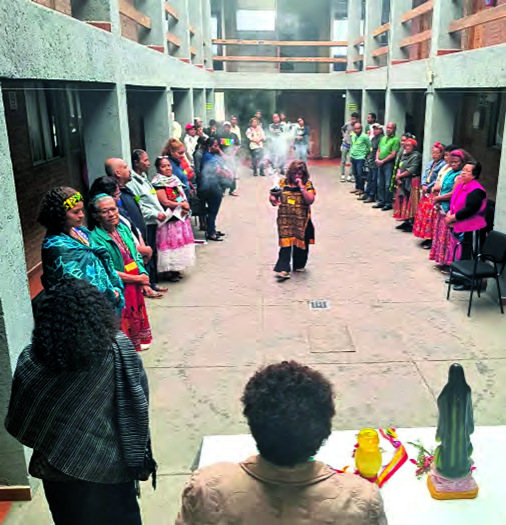
Talking to God and talking about Him from our originality. How can we think and talk about God as people of African descent? How can we reflect, as Mexicans with African roots, from the Word of God and from our reality? Without a doubt, the pillars of our understanding of God are Africa and Mexico as places from which God has formed us and from which He has infused us with His Spirit.
Brother Joel CRUZ, mccj
As Christians, the Bible and Jesus Christ certainly frame these theological places (from where God speaks to us: Africa and Mexico), which is why the faith of our African ancestors and the event of Guadalupe are fundamental sources of our Afro-descendant Mexican identity. From there we “drink” the Spirit of God that gives us a specific ecclesial face. This is what allows us to think and speak about the Father in a different way in the Church and in society.
For many, it is impossible or scandalous to believe that God can be conceived outside the parameters of European Christian thought. This is because it is believed that the perception of the Creator held by African ethnic groups, people of African descent, and indigenous peoples is erroneous and pagan.
It is forgotten or unknown that Christianity was possible in the world because Africa conceived, nurtured, and formed this path of salvation for humanity.
In fact, it is no secret that Moses was educated in Africa, that Jesus was protected from death in Africa (Matthew
2:13)... In short, Africa plays a role in the Bible in terms of salvation, leadership training, and the gestation of processes of organization and liberation of God's people.
Turning our gaze to the theological thoughts and languages connected with Africa and with the indigenous peoples of Mexico, particularly with the Guadalupe event, will not only make our conception of God different, but will also shed light on the prevailing ecclesial understanding and languages, helping us to better understand the Father in today's social and cultural conditions.
Many of us continue to think about God and speak of Him from the conception brought from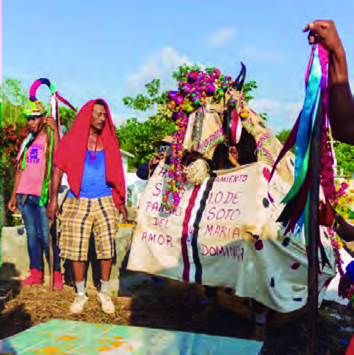 Europe and implanted, in various ways, in our ancestors who were enslaved and colonized in Mexico. It is not an original theological reflection, made with the “ingredients” of our roots, but rather “imported” and, perhaps because of this, the center of our identity as individuals and as peoples lies outside of us.
It is not a question of “adapting” ourselves, nor of seeking that the Church be ‘condescending’ to our religious expressions, as if “giving us permission” to perform them in some liturgical celebrations. No. It is a matter of discovering God with the characteristics with which He reveals Himself to us from those places that are the origins of our being, and then showing Him to the Church and to society, just as He is revealed to us in our history, in our realities, and in the places that are the origins of our own humanity.
It is very important to “awaken Afro-descendant theological consciousness” so that our ecclesial and social presence is not only meaningful, but also a light for other peoples. That is why it is necessary to go beyond the ways in which we present ourselves in the Church and in society and share the essence of our being, created by God and nourished by roots connected to Africa, with its thought and language. If we do not do this, our ecclesial and social presence will be understood as “slave folklore,” the result of the encounter between African, Spanish, and indigenous traditions in Mexico.
The recovery, reconstruction, and affirmation of Mexican Afro-descendant identity, if we want it to be truly liberating, enlightening, and transformative of ecclesial and social realities, must begin precisely from the structuring of an Afro-descendant thought and language of God, and not so much from the socio-economic and political problems that affect us. In other words, it must start from a theology connected to our roots, to the essence of our origins, in order to overcome the anthropological impoverishment suffered by our Afro-descendant peoples, which places them in a position of ethnic, cultural, and spiritual inferiority...
Thinking and talking about God is what we call faith. And our peoples have maintained it. In fact, this faith was the source of their resistance to the dehumanization of slavery, and today it continues to be a source of strength in the face of adversity. For many people in the Church, the names they used to call God and the ways they communicated with Him are a problem, because they are different from what was established as “universal” and “unique.”
The mission is to help all people understand that God “became incarnate in black flesh,” and therefore, He is also black, and communicates through the thoughts and language of black peoples. The Church and society must understand and accept this, because our experience of faith in God, as people of African descent, is what other peoples lack in order to understand and know God more fully.
In Mexico, the Church still has a long way to go in terms of acceptance, in order to understand that the people of God are made up of many peoples and are multicultural. That understanding of the Creator involves interculturality and that, together, we are helping each other to understand Him better and to discern His will.